
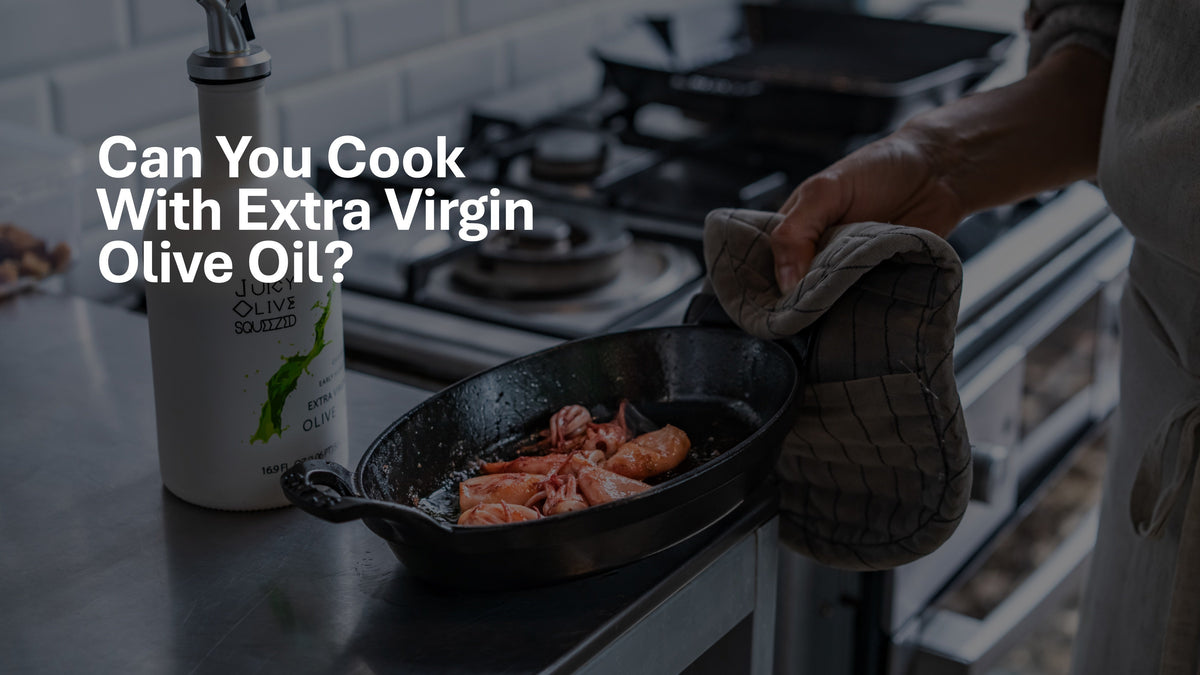
Yes. Extra virgin olive oil is suitable for cooking—including sauteing, roasting, baking and frying.
The idea that EVOO should only be used cold is misleading. A good extra virgin olive oil combines a high proportion of monounsaturated oleic acid with naturally occurring antioxidants and phenolic compounds that help it resist oxidation during cooking.
You can cook with EVOO.
Heat reduces some delicate aromas and polyphenols, especially at higher temperatures and over longer cooking times. But that does not make extra virgin olive oil unsuitable for cooking.
What Is the Smoke Point of Extra Virgin Olive Oil?
There is no single universal smoke point for EVOO.
The temperature at which an olive oil begins to smoke varies with its grade, quality, freshness, free acidity, composition and storage. UC Davis cites published olive-oil smoke points across a broad range of approximately 175–240°C (347–464°F).
That range is more useful than assigning every EVOO one fixed number.
| Cooking Method | Typical Temperature |
|---|---|
| Gentle sauteing | 120–160°C |
| Pan cooking | 150–180°C |
| Frying | 160–180°C |
| Very hot frying | 175–190°C |
| Published olive-oil smoke points | Roughly 175–240°C, depending on the oil |
The practical point: do not judge every extra virgin olive oil by one fixed smoke-point number.
Smoke Point Is Not the Whole Story
Smoke point is useful, but it does not tell you everything about how an oil performs under heat.
Another important factor is oxidative stability—how well an oil resists deterioration when exposed to heat and oxygen.
EVOO performs well because it combines a high proportion of monounsaturated oleic acid with naturally occurring antioxidants and phenolic compounds.
Recent research on virgin olive oils also found free acidity to be an important predictor of smoke point, while cautioning against using smoke point alone to choose an oil for frying.
What Happens to Polyphenols When EVOO Is Heated?
Heat does reduce some olive-oil polyphenols.
How much is lost depends on temperature, cooking time, oxygen exposure, the food being cooked and the individual phenolic compounds.
Higher heat + longer cooking = generally greater loss of delicate polyphenols and aromas.
But heating does not instantly destroy everything valuable in EVOO. Some phenolic compounds and antioxidant activity can remain after cooking, while the oil's monounsaturated-fat profile remains.
A useful kitchen strategy is simple:
Cook with EVOO. Finish with EVOO.
Use it in the pan, then add a fresh drizzle before serving when you want more of the original aroma, pepperiness and fresh-oil character.
Can You Fry With Extra Virgin Olive Oil?
Yes.
The International Olive Council describes olive oil as particularly suitable for frying and lists frying temperatures around 180°C as a practical reference.
Research under deep-frying conditions has also found olive oils to resist oxidation well, with natural antioxidant content contributing to performance.
As with any cooking oil, avoid unnecessarily overheating it until it is smoking heavily. If the pan is producing significant smoke, reduce the heat.
Can You Bake With Extra Virgin Olive Oil?
Yes. EVOO works very well for baking, including cakes.

It can replace other liquid cooking oils in many recipes and helps produce cakes with a moist, tender texture. Its flavor can work especially well with chocolate, citrus, nuts and fruit-based cakes.
For a softer olive-oil taste, choose a milder EVOO. Juicy Olive Relish & Smooth is our gentlest profile and a natural choice for cakes, muffins and other baking.
Tip: If a recipe specifically uses butter, substitution may require some adjustment because butter and olive oil have different compositions.
Which Juicy Olive EVOO Suits Which Dish?
Juicy Olive is our range of certified-organic, early-harvest extra virgin olive oils from a single family estate in the historic Troy region of Türkiye.
All three profiles are suitable for cooking. The main difference is their polyphenol level and flavor intensity, so you can choose according to how bold or smooth you want the olive oil to taste in your food.
| Juicy Olive Profile | Polyphenols | Free Acidity | Kitchen Fit |
|---|---|---|---|
| Fruity & Full-Bodied | 840 mg/kg | ≤0.20% | Finishing, vegetables, eggs, bold dishes |
| Mild & Flavorous | 620 mg/kg | ≤0.30% | Sauteing, seafood, vegetables |
| Relish & Smooth | 440 mg/kg | ≤0.50% | Roasting, baking, sauces, marinades |
Juicy Olive's published results also show peroxide values below 7 meq O2/kg across the three profiles.
840 · 620 · 440
Not different quality grades.
Three different levels of olive character for your kitchen.
If you want the boldest olive character, choose Fruity & Full-Bodied. For a versatile middle profile, choose Mild & Flavorous. For roasting, baking and recipes where you want a gentler taste, choose Relish & Smooth.
Choose the flavor intensity that fits your kitchen.
Explore the Three Profiles →Does Low Acidity Matter for Cooking?
Quality matters under heat, too. Recent research found that higher free acidity was strongly associated with a lower smoke point in virgin olive oils.
Juicy Olive's published free-acidity results range from ≤0.20% to ≤0.50%. These are favorable quality results, but they should not be converted into a claimed smoke-point temperature without directly measuring the oil.
For more on what acidity actually tells you, read our Low-Acidity Olive Oil Guide.
Frequently Asked Questions
Can you cook with extra virgin olive oil at high heat?
Yes. Quality EVOO can be used for many higher-temperature cooking methods, including roasting and frying. Avoid heating any oil beyond what the food requires or allowing it to smoke heavily.
What is the smoke point of extra virgin olive oil?
There is no single universal number. Published olive-oil smoke points span roughly 175–240°C, depending on grade, quality, freshness and the individual oil.
Does cooking destroy olive-oil polyphenols?
Cooking reduces some polyphenols, especially as temperature and exposure time increase, but it does not instantly eliminate all phenolic compounds or antioxidant activity.
Is EVOO safe for frying?
Yes. The International Olive Council describes olive oil as particularly suitable for frying, and research supports its stability under frying conditions when used appropriately.
Should I use high-polyphenol EVOO for cooking?
Yes. High-polyphenol EVOO can be an excellent cooking oil. If you also want maximum fresh aroma and original phenolic character, add a little raw EVOO after cooking.
The Bottom Line
Yes—you can cook with extra virgin olive oil.
Smoke point alone does not determine whether an oil is suitable for cooking. Quality EVOO combines monounsaturated fats with natural antioxidants and olive polyphenols that contribute to oxidative stability.
Heat will reduce some aromas and phenolic compounds, particularly with prolonged high temperatures. But that is not a reason to keep EVOO out of the pan.
Cook with EVOO. Finish with EVOO.
Choose Your Taste Profile
Three certified-organic early-harvest EVOOs. One estate. Three levels of flavor intensity.
Explore Juicy Olive →Related Juicy Olive Guides
Scientific References
UC Davis — Olive Oil Myths and Facts
International Olive Council — Cooking With Olive Oil
Diez-Betriu et al. — Smoke Point in Virgin Olive Oils (Foods, 2025)
Casal et al. — Olive Oil Stability Under Deep-Frying Conditions (Food and Chemical Toxicology, 2010)
Comments