
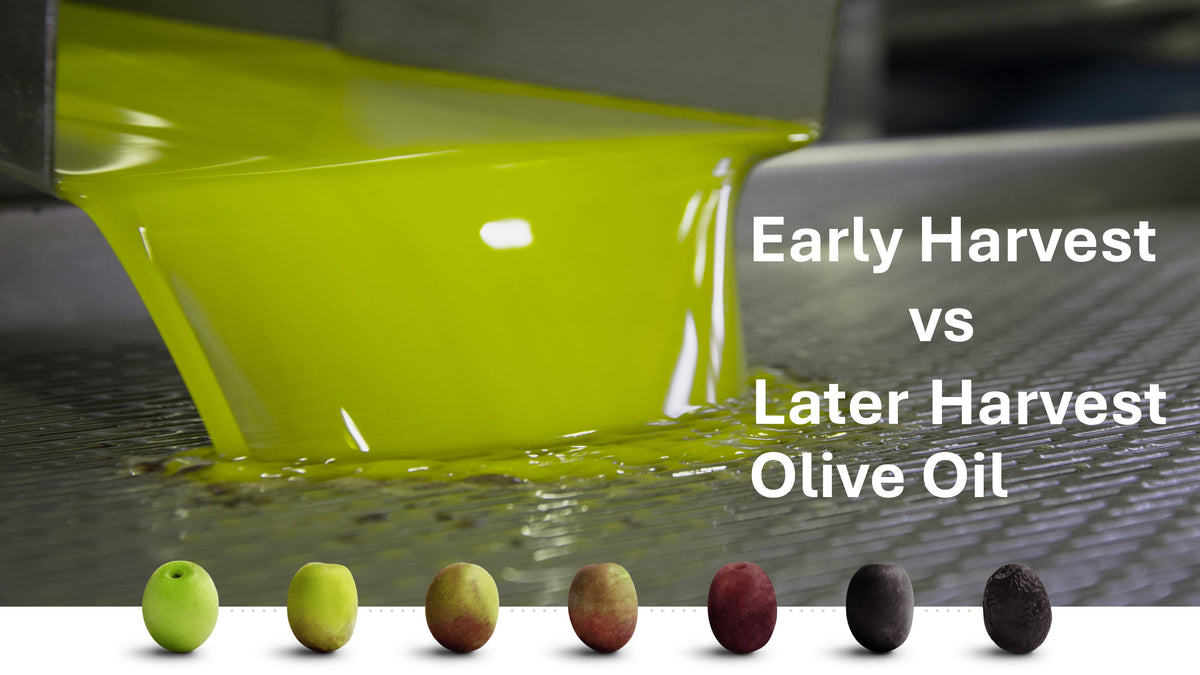
When olives are harvested changes the oil in the bottle.
As olives ripen, they generally produce more oil. The finished oil often becomes softer, less bitter and less peppery, and phenolic concentration and oxidative stability can decline.
Early harvest is not automatically higher quality. It is a choice to pick the fruit earlier and take less oil.
Early-harvest olive oil is made from olives picked while the fruit is still relatively green.
Compared with a later harvest, that choice often means less oil, greener aroma, and higher phenolic potential. Cultivar, season, fruit health, pressing and storage still decide the finished oil. The polyphenol number has to come from a laboratory.
Why Harvest Earlier?
As olives mature, oil accumulation generally increases. Waiting longer can produce more oil from the same fruit.
What that earlier fruit can offer, when the rest of the process is sound:
- higher phenolic potential,
- greener aroma,
- more noticeable bitterness and pungency,
- and greater oxidative stability.
Research across cultivars shows that earlier harvest stages can produce oils with higher phenolic concentrations. The exact result varies with cultivar, climate and crop year.
Early harvest is a production decision, not a grade above extra virgin.
Does Early-Harvest Olive Oil Have More Polyphenols?
Often, and not always.
Earlier harvesting often produces oils with higher concentrations of phenolic compounds. Those compounds contribute to bitterness, pepperiness and oxidative stability.
The words “early harvest” do not guarantee a polyphenol number. Cultivar, climate, fruit condition, pressing and storage also matter. If polyphenols matter to you, read the laboratory measurement.
Read more in our Olive Oil Polyphenols Guide.
What a Phenolic Result Can and Cannot Claim
An earlier harvest can leave more of the phenolic compounds that refining, or a later ripeness, would reduce. That is greater phenolic potential. It is not, by itself, a health claim.
The EU authorizes one specific polyphenol claim, and only when a separate laboratory test is met: olive oil polyphenols contribute to the protection of blood lipids from oxidative stress. The oil must provide at least 5 mg of hydroxytyrosol and its derivatives per 20 g of olive oil, and the beneficial effect is obtained with a daily intake of 20 g.
A total-polyphenol number does not prove eligibility for that claim. Juicy Olive’s 840, 620 and 440 mg/kg figures are measured total polyphenols.
Early Harvest vs. Later Harvest
| Characteristic | Early Harvest | Later Harvest |
|---|---|---|
| Oil yield | Lower | Higher |
| Polyphenol potential | Often higher | Often lower |
| Aroma | Green, fresh, herbaceous | Softer, riper |
| Bitterness | More noticeable | Gentler |
| Pepperiness | Often stronger | Usually softer |
| Oxidative stability | Often higher | Can decline as the fruit ripens |
| Fruit required | More fruit per litre of oil | Less fruit per litre of oil |
These are general patterns. Cultivar, climate and how the oil is pressed and stored can change the result.
Is Early Harvest Higher Quality?
No. Early harvest is not automatically higher quality.
It is the stronger place to start when the goal is greener flavor and higher phenolic potential. Fruit health, a fast press, temperature and storage still decide whether that potential is in the bottle.
At Juicy Olive, the priority is the character of the fruit and a laboratory result, not the maximum volume of oil.
Can You Taste an Early Harvest?
Often. An early-harvest extra virgin olive oil frequently shows more:
Fresh olive, grass, herbs, artichoke or tomato leaf.
A positive characteristic of virgin olive oil, often more noticeable in an earlier harvest.
The peppery sensation in the throat. Oleocanthal is particularly associated with that sensation. Other phenolic compounds also contribute.
In fresh extra virgin olive oil, bitterness and pungency are part of the fruit. They are not a defect, and they are not a polyphenol measurement.
The glass gives clues. The laboratory gives measurements.
What Does Juicy Olive’s Own Harvest Show?
All three Juicy Olive profiles come from the same certified-organic family estate in the Troy region of northwestern Türkiye.
What changes is when we harvest. All three are early-harvest expressions. Early September is later in our window than early August. It is not a lower grade.
| Juicy Olive Profile | Harvest | Total Polyphenols | Free Acidity | Character |
|---|---|---|---|---|
| Fruity & Full-Bodied | Early August | 840 mg/kg | ≤0.2% | Bold, herbaceous, structured, strongly peppery |
| Mild & Flavorous | Mid-August | 620 mg/kg | ≤0.3% | Fresh, herbaceous, balanced, rounded |
| Relish & Smooth | Early September | 440 mg/kg | ≤0.5% | Silky, delicate, rounded |
840 → 620 → 440 mg/kg
Early August is our most intense profile and our highest measured total, 840 mg/kg. Later in the same early-harvest window, the oils become softer. The three numbers are measurements, not three grades.
These are not three quality grades. They are three harvest expressions from the same estate.
Fruity & Full-Bodied — 840 mg/kg
Early August. Bold, herbaceous, structured, and strongly peppery, with a long finish. For finishing and drizzling.
Mild & Flavorous — 620 mg/kg
Mid-August. Fresh, herbaceous, balanced, and rounded. For salads, seafood, dips, and fresh dishes.
Relish & Smooth — 440 mg/kg
Early September. Silky, delicate, and rounded, with gentle fruitiness. For roasting, baking, marinades, and sauces.
One estate. Three harvest expressions.
Compare the three harvest expressions.
Explore the Three Profiles →Why Does a Fast Press Matter?
Harvesting early is only the choice of fruit.
Once the olives leave the tree, delay works against the freshness that choice was meant to keep.
At Juicy Olive, the olives are cold pressed on the estate within two hours of harvest, with the olive paste kept below 22°C.
The harvest chooses the fruit. The press and the temperature carry that fruit into the oil.
Can You Cook With Early-Harvest Extra Virgin Olive Oil?
Yes. Early-harvest extra virgin olive oil is suitable for everyday cooking and for using raw.
Phenolic compounds contribute to oxidative stability. Prolonged high heat can still soften delicate aromas. Keeping the earliest, most intense bottle for finishing is a flavor choice.
Why Does Early-Harvest Olive Oil Cost More?
The main reason is yield.
Harvesting before the fruit reaches its highest oil accumulation means more olives are picked and pressed for the same amount of oil.
Less oil from the same fruit, in exchange for the character of an earlier harvest.
What Should You Check Before Buying?
A label that says Early Harvest is the start of the question, not the answer.
- Is the legal category extra virgin olive oil?
- Who produced it, and where?
- Is the harvest period stated?
- How soon was the fruit pressed?
- Is there a laboratory result?
- Is the polyphenol figure a measurement, with a method?
- Is free acidity reported?
- Can the batch be traced?
See What Makes Premium Extra Virgin Olive Oil and Certificates & Laboratory Results.
Frequently Asked Questions
Is early-harvest olive oil better?
Early harvest is not automatically higher quality. It usually means less oil and, in many cultivars, a greener oil with higher phenolic potential. Fruit health, pressing and storage still decide the finished oil.
Does early-harvest olive oil have more polyphenols?
Often, but not always. Earlier harvest stages frequently produce higher phenolic concentrations. Cultivar, climate and season change the result, so the number has to come from a laboratory measurement.
Why is early-harvest olive oil more expensive?
Greener olives generally give less oil, so more fruit is pressed for each litre.
Is peppery olive oil a good sign?
Pepperiness is a positive sensory characteristic of fresh virgin olive oil and is associated with phenolic compounds, including oleocanthal. It is a clue. The laboratory measurement is the polyphenol number.
Is later-harvest olive oil always poor quality?
No. Later fruit can still produce extra virgin olive oil when the fruit is healthy and the oil is pressed and stored with care. A later harvest usually means more oil and a softer sensory profile.
Can you cook with early-harvest olive oil?
Yes. Early-harvest extra virgin olive oil is suitable for everyday cooking and for using raw. Prolonged high heat can soften some delicate aromas.
What to Remember
Harvest timing is one of the producer’s decisions.
Waiting longer can give more oil.
Harvesting earlier can give more phenolic potential, greener flavor, bitterness, pungency and oxidative stability. It does not, by itself, make the oil higher quality.
Juicy Olive harvests early, then cold presses within two hours. The three profiles are three moments in that window, and each one has its own measured polyphenol total.
840. 620. 440.
Not three quality grades.
Three ways to taste the harvest.
Choose Your Harvest Expression
Three certified-organic early-harvest extra virgin olive oils from one family estate.
Explore the Juicy Olive Collection →
Comments