
Olive Oil Production Guide
Freshly extracted olive oil can naturally contain tiny droplets of vegetation water and microscopic olive solids, giving it a cloudy or “veiled” appearance.
That cloudiness can be normal at the beginning. But olive oil intended for longer storage should not remain in prolonged contact with significant moisture and sediment.
Producers generally clarify the oil in two main ways: filtration or controlled natural settling and decantation.
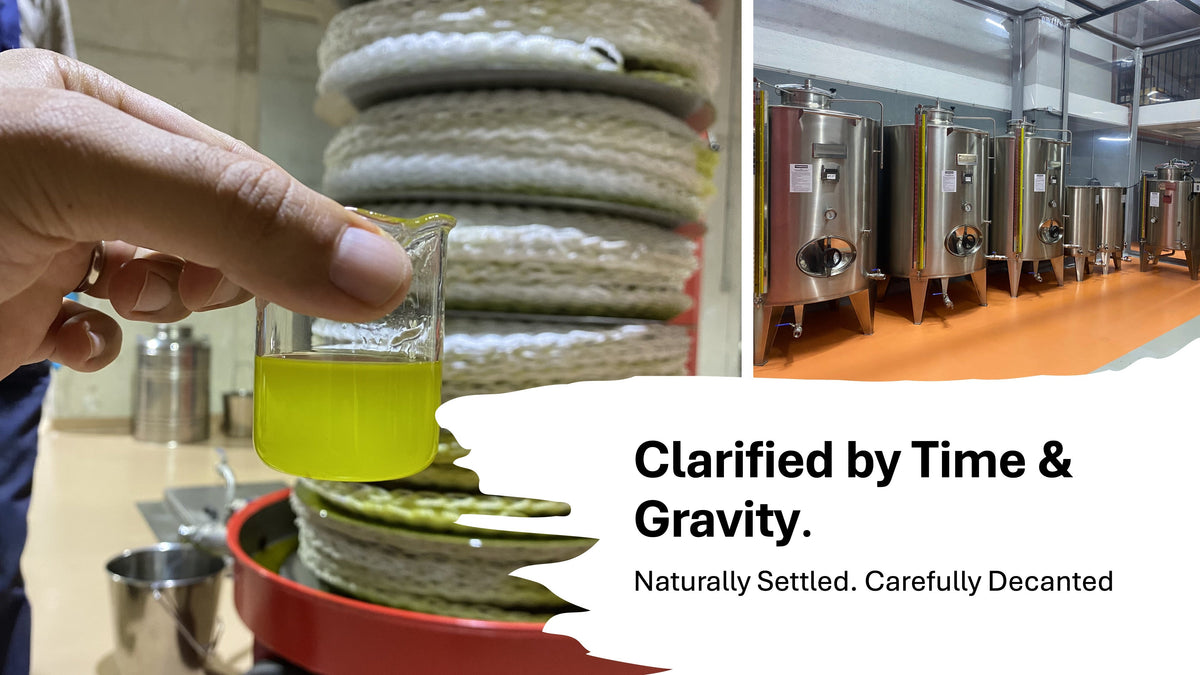
 Freshly extracted olive oil during milling, before clarification.
Quick Guide: Two Ways to Clarify Olive Oil
| Method | How It Works | Main Advantage |
|---|---|---|
| Filtration | Filter media remove suspended water and olive solids. | Fast and effective clarification. |
| Natural Settling & Decantation | Gravity separates the material before clearer oil is repeatedly transferred into clean tanks. | Gradual clarification without immediate filter media. |
Fresh olive oil may begin cloudy, but proper clarification helps protect it during extended storage.
Why Is Fresh Olive Oil Cloudy?
After extraction, tiny droplets of water and microscopic olive particles can remain suspended in the oil. These particles scatter light and make the oil look cloudy.
This does not automatically mean the oil is spoiled. Very fresh oils are sometimes intentionally consumed while cloudy because of their young, intense character.
The issue is time. Too much moisture and sediment left in the oil for extended periods can contribute to undesirable chemical and sensory changes.
Cloudiness can be normal in freshly extracted oil. It is not necessarily ideal for extended storage.
Why Should Olive Oil Be Clarified?
Clarification is not simply about appearance. Its purpose is to remove residual water and olive solids before longer storage.
These materials can encourage fermentation, hydrolytic reactions and other changes that may shorten shelf life or create unwanted flavors.
Good storage also means protecting olive oil from oxygen, heat and light. Clarification is one part of that wider quality-control process.
Method One: Filtration
Filtration removes suspended moisture and olive solids by passing the oil through suitable filter media.
Its biggest advantage is speed: the oil can be clarified relatively quickly before longer storage or bottling.
Filtration may also change some minor compounds in the oil. Research has found different effects on phenolics, aromas and flavor depending on the system, cultivar, starting oil and storage conditions.
So it is too simple to say that filtration always removes polyphenols or flavor. It is one legitimate method of clarification.
Method Two: Natural Settling and Decantation
Natural settling takes a slower approach. Instead of immediately filtering the oil, the producer allows gravity to separate the suspended material.
Heavier water droplets and olive solids gradually move toward the bottom of the tank. The clearer oil is then transferred into another clean tank, leaving the settled material behind.
This transfer is called decantation or racking. As more fine material settles, the process can be repeated until the desired clarity is reached.
Settling separates. Decantation moves the clearer oil away. Repeated decantation progressively clarifies the oil.
 Stainless-steel tanks used for controlled natural settling and repeated decantation.
Is Naturally Settled Olive Oil Still “Unfiltered”?
Technically, it can be—if no filter media were used.
But “unfiltered” can be misleading because consumers often imagine permanently cloudy oil with visible sediment in the bottle.
After controlled settling and repeated decantation, much of that material has already been removed. A more accurate description can therefore be naturally clarified or naturally settled and decanted.
The aim is not to preserve sediment. The aim is to remove it through gravity and careful transfers.
Is Sediment in the Final Bottle Good?
Significant sediment is generally not something consumers should seek out in olive oil intended for normal storage.
A small amount does not automatically mean the oil is spoiled. But more sediment does not mean the oil is more natural, healthier or better.
Residual moisture and olive solids can reduce storage stability if they remain in contact with the oil for too long.
Fresh cloudy oil can be normal. Olive oil stored for months should be properly clarified.
Does Clarification Remove Polyphenols?
It depends on the method.
Filtration can affect some phenolic and aromatic compounds, but research does not show one universal result. Natural settling avoids immediate filter media, but it requires time and careful tank management.
Neither method should therefore be described as automatically superior.
If a producer wants to demonstrate polyphenol levels, the strongest evidence is a laboratory measurement—not cloudiness or the word “unfiltered.” Read our High-Polyphenol Olive Oil Buyer’s Guide.
Our Production Approach
How Juicy Olive Uses Repeated Decantation
At Juicy Olive, we use controlled natural settling and repeated decantation as our primary clarification approach.
After extraction, the oil is transferred into stainless-steel tanks under controlled conditions. Gravity gradually separates residual moisture and heavier olive material.
The clearer oil is then carefully transferred into a clean tank, leaving the settled material behind. As additional fine sediment appears, the oil is transferred again.
The process is repeated as needed until the desired clarity is reached. Our settling period typically lasts around three to four weeks at approximately 16°C, while nitrogen helps limit unnecessary oxygen exposure inside the tanks.
The aim is simple: remove water and sediment before extended storage while allowing gravity and time to perform the clarification gradually.
Filtered or Naturally Settled: Which Is Better?
Both methods can produce excellent extra virgin olive oil.
Filtration offers fast clarification. Controlled settling and repeated decantation achieve clarification more gradually.
The bigger question is whether the producer properly managed the oil after extraction.
Look beyond “filtered” or “unfiltered” and consider:
- harvest freshness,
- origin and traceability,
- extraction quality,
- clarification,
- storage conditions,
- protection from oxygen and light,
- laboratory results,
- and sensory quality.
Fresh olive oil may naturally begin cloudy, but oil intended for extended storage should be properly clarified. Filtration and controlled natural settling are two valid ways to achieve it.
Frequently Asked Questions
Should olive oil contain sediment?
Very fresh olive oil may contain sediment, but significant sediment should generally be removed before extended storage.
Is filtered olive oil lower quality?
No. Filtration is a legitimate clarification method and does not automatically mean lower quality.
Does filtration reduce polyphenols?
It can affect some phenolic compounds, but the result depends on the filtration method, the oil and storage conditions.
What is repeated decantation?
It means allowing sediment to settle naturally, transferring the clearer oil into a clean tank, then repeating the process as additional sediment separates.
Is naturally settled olive oil unfiltered?
It can technically be unfiltered if no filter media were used. However, “naturally clarified through settling and decantation” is often a more accurate description.
Sources & Further Reading
- International Olive Council — Olive oil standards and storage guidance.
- UC Davis, UC Food Quality — Olive Oil Processing.
- UC Davis, UC Food Quality — Olive Oil Quality.
- Frangipane, Cecchini, Monarca & Massantini (2023). Effects of Filtration Processes on the Quality of Extra-Virgin Olive Oil—Literature Update. Foods 12(15), 2918.
Comments