
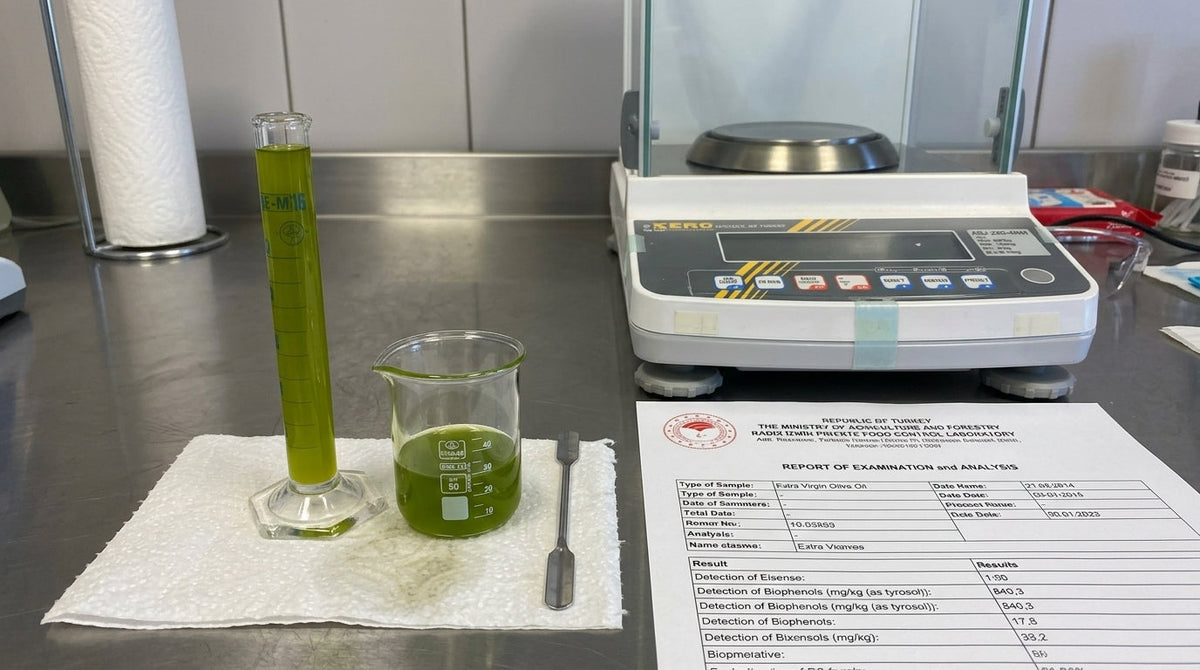
Read Beyond the Label.
A beautiful bottle can attract attention. An olive oil laboratory report tells you what evidence stands behind it.
You do not need advanced chemistry. Focus on a few useful measurements: polyphenols, free acidity, peroxide value, K values and whether the report belongs to the oil being sold.
Olive Oil Lab Report: Quick Buyer’s Guide
| Measurement | What it tells you | Strong buying signal |
|---|---|---|
| Polyphenols | Measured phenolic richness, linked to bitterness, pepperiness and antioxidant character | A higher result when testing methods are comparable |
| Free acidity | Fruit condition and handling before extraction | Low acidity, comfortably below 0.80% |
| Peroxide value | Early oxidation detected in the tested sample | A low result, below 20 meq O₂/kg |
| K232 | Changes associated mainly with earlier oxidation | At or below 2.50 |
| K268 / K270 | Clues related to later oxidation or refining processes | At or below 0.22 |
| ΔK | Whether the UV pattern supports the declared category | At or below 0.01 |
The values above are current EU reference limits for extra virgin olive oil. EVOO must also show positive fruitiness and have no median sensory defect. [1]
1. First, Check Which Olive Oil Was Tested
Before studying the numbers, confirm that the report identifies the product or sample, harvest or batch, analysis date, laboratory, testing method and units used.
A report only describes the sample that was tested. An impressive result from an older harvest does not automatically describe the bottle currently being sold.
2. Polyphenols: Look for a High, Verified Result
Polyphenols are naturally occurring compounds in olives and extra virgin olive oil. They contribute to bitterness, pepperiness, early-harvest intensity, antioxidant character and resistance to oxidation.
Polyphenol levels are commonly reported in mg/kg, meaning milligrams per kilogram. A result of 840 mg/kg means the tested sample produced a measured phenolic result of 840 milligrams per kilogram under the analytical method used.
Is a higher polyphenol result better?
For buyers specifically seeking high-polyphenol olive oil, a higher verified result is generally more desirable. When the laboratory methods and reporting bases are comparable, the higher number indicates a greater measured concentration of phenolic compounds.
It may also correspond with a more intense bitter and peppery taste.
Why the testing method matters
Different laboratory methods can measure and report phenolic content differently. The International Olive Council recognizes HPLC-based analysis for determining olive-oil biophenols. Before comparing two brands, check whether comparable analytical methods and units were used. [2]
Want a deeper explanation? Read our Olive Oil Polyphenol Guide.
3. Free Acidity: Lower Is a Strong Quality Signal
Free acidity does not describe whether the oil tastes sour or acidic. It is a laboratory measurement of free fatty acids, expressed as a percentage of oleic acid.
A lower result is generally desirable. Very low free acidity is commonly associated with healthy fruit, careful harvesting and transport, minimal bruising, prompt processing and controlled production.
An oil measuring 0.20% or 0.30% sits far below the extra virgin limit and provides a strong quality signal.
See how to interpret acidity numbers in our Low-Acidity Olive Oil Guide.
4. Peroxide Value: Look for Low Oxidation
Peroxide value measures primary oxidation products in the tested olive oil.
A lower result means fewer primary oxidation products were detected when the sample was analyzed. It is still a snapshot: heat, light, oxygen and poor storage can continue to affect an oil after testing.
5. K232, K270 and ΔK: The Simple Explanation
K values help laboratories evaluate oxidation and whether the oil’s ultraviolet absorption pattern supports its declared category.
K232
Helps identify changes associated mainly with earlier oxidation. EVOO reference: ≤2.50
K268 or K270
Provides clues related to later oxidation and changes that can be associated with refining. EVOO reference: ≤0.22
ΔK
Helps confirm that the ultraviolet absorption pattern is consistent with the declared category. EVOO reference: ≤0.01
What to Check
K232, K268/K270 and ΔK should all be comfortably within the extra virgin limits—not merely one of them.
The current EU limits for extra virgin olive oil are free acidity ≤0.80%, peroxide value ≤20, K232 ≤2.50, K268/K270 ≤0.22 and ΔK ≤0.01. [1]
How to Compare Two Olive Oils in 30 Seconds
Higher verified polyphenols
When methods are comparable, the higher result indicates greater measured phenolic concentration.
Lower free acidity
A result far below 0.80% supports careful fruit handling and prompt processing.
Low peroxide value
This shows that limited primary oxidation was detected when the sample was tested.
Compliant K values
K232, K270/K268 and ΔK should all sit within extra virgin limits.
A recent report
The analysis should relate to the oil, harvest or batch currently being offered.
Clear provenance
Look for the producer, origin, harvest timing and processing information.
Reading Juicy Olive’s Three Profiles
Juicy Olive publishes laboratory measurements for three certified-organic, single-estate harvest expressions from the same family grove.
| Juicy Olive profile | Polyphenols | Free acidity | Peroxide value | Why choose it |
|---|---|---|---|---|
| Fruity & Full-BodiedBoldest expression | 840 mg/kg | ≤0.20% | <7 meq O₂/kg | Highest polyphenols, lowest acidity and boldest peppery character |
| Mild & FlavorousBalanced expression | 620 mg/kg | ≤0.30% | <7 meq O₂/kg | High-polyphenol intensity with a fresh, balanced profile |
| Relish & SmoothGentlest expression | 440 mg/kg | ≤0.50% | <7 meq O₂/kg | A gentler, smoother expression for cooking and everyday use |
Review the latest measurements on our Certificates and Lab Results page.
These are three expressions of one estate—not three different quality categories.
Choose according to your preferred intensity
Fruity & Full-Bodied — 840 mg/kg: choose it for Juicy Olive’s highest published polyphenol level, lowest acidity and strongest peppery finish.
Mild & Flavorous — 620 mg/kg: choose it for high polyphenols with a balanced, fresh and herbaceous character.
Relish & Smooth — 440 mg/kg: choose it for a softer, rounded profile suited to marinades, sauces, baking and roasting.
Juicy Olive’s current harvest-verification table publishes polyphenols of 840, 620 and 440 mg/kg, free acidity from ≤0.20% to ≤0.50%, and peroxide values below 7 meq O₂/kg across the three profiles. [3]
Why Juicy Olive Stands Out on the Lab Report
- Up to 840 mg/kg polyphenols
- Free acidity as low as ≤0.20%
- Peroxide values below 7 meq O₂/kg
- Early-harvest olives
- Single-estate traceability
- Certified-organic production
- Processing within two hours
- Published laboratory results
Frequently Asked Questions
What is the most important number on an olive oil lab report?
For buyers seeking a premium, phenolic-rich EVOO, start with polyphenols and free acidity. Then check peroxide value and K values to confirm that the wider report supports the oil’s quality and extra virgin classification.
Is a higher polyphenol result better?
For customers seeking greater measured phenolic richness, generally yes—provided the oils were tested using comparable analytical methods. A higher result can also correspond with stronger bitterness and pepperiness.
Is lower free acidity better?
In general, yes. Lower free acidity is a desirable quality signal and is commonly associated with healthy fruit, careful handling and prompt processing. It should still be considered alongside peroxide value, K values, sensory quality and the report date.
Can I taste free acidity?
No. Free acidity is a laboratory measurement and is not the same as sourness. You cannot accurately determine a percentage such as 0.20% or 0.50% by tasting the oil.
Does a laboratory report prove that an olive oil is extra virgin?
A chemical report supports the classification, but extra virgin olive oil must also meet sensory requirements. Under EU standards, EVOO must show positive fruitiness and have a median sensory defect of zero. [1]
How recent should an olive oil lab report be?
The most useful report is one connected to the current product, harvest or batch. A result from a previous crop should not automatically be used to describe a newer harvest.
Read the Report. Choose the Stronger Evidence.
A premium bottle can make a promise. A strong laboratory report helps prove it. Juicy Olive brings together higher verified polyphenols, lower free acidity, low oxidation markers, recent testing and traceable production across three profiles from one certified-organic family estate.
Higher polyphenols. Lower acidity. Clear laboratory evidence.
Explore the Juicy Olive Collection →Sources & Standards
Comments